


The Laboratory of Functional Materials Mechanics is part of the Department of Complex Problems in Mechanics of Deformable Bodies.
Head of the Department: Matveenko Valery Pavlovich
Phone number: +7 (342) 237-84-61
E-mail:
Head of the Laboratory: Lekomtsev Sergey Vladimirovich
Phone number: +7 (342) 237-83-99
E-mail:
The Laboratory of Modeling Thermomechanical Processes in Solids was created in 1983 on the basis of the Group of Statics and Dynamics of Viscoelastic Structures. Until 2023, the Laboratory was headed by Academician of RAS, Doctor of Technical Sciences V.P. Matveenko. In 2018, a new research team, the Young Scientists Laboratory of Functional Materials Mechanics, seceded from the Laboratory of Modeling Thermomechanical Processes in Solids and was headed by S.V. Lekomtsev, PhD in Physics and Mathematics. In 2024, the laboratories merged and became part of the Department of Complex Problems in Mechanics of Deformable Bodies.
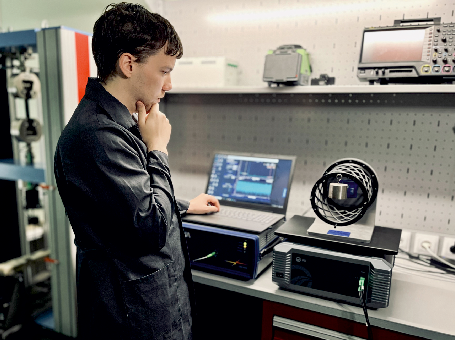
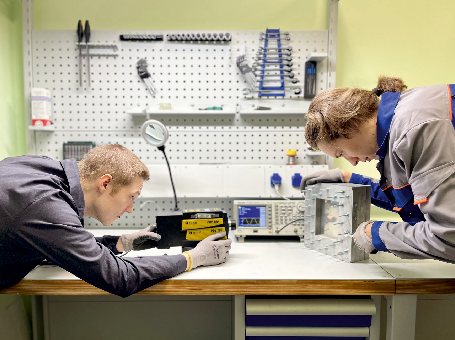
The main direction of laboratory research involves mathematical formulation and numerical modeling of static behavior, vibration and stability of deformable bodies made of elastic, viscoelastic and functionally graded smart and metamaterials with various types of actuators and sensors. Within these areas, the Laboratory team solves a broad range of mathematical problems associated with integrating fiber-optic sensors into structural materials at the stage of manufacture, monitoring the deformation of these materials at the operation stage, and assessing the capability of smart materials to adapt the geometry and dynamic characteristics of structures to external loads.
Alongside theoretical research, the laboratory conducts experiments to verify the results of numerical simulations, to assess the mechanical effects that emerge, and to demonstrate their applications through the use of structurally similar models.

Numerical and experimental studies of smart systems with piezoelements, fiber-optic sensors and shape memory alloys
Kamenskikh A.O. et al. Int. J. Appl. Mech. 2024. V. 16. No. 7. Article No. 2450072
Fedorov A.Y. et al. Composite Struct. 2020. V. 239. Article No. 111844

Passive damping of thin-walled structures using piezoelements connected to electric circuits
Iurlova N.A. et al. Int. J. Smart Nano Mater. 2019. V. 10. No. 2. P. 156–176
Lekomtsev S.V. et al. Mech. Adv. Mater. Struct. 2024. V. 31. No. 1. P. 164–180

Modeling of natural vibration and study of the stability of deformable bodies interacting with liquid and gas
Bochkarev S.A., et al. Thin-Wall. Struct. 2021. V. 164. Article No. 107867
Lekomtsev S.V. et al. Cont. Mech. Thermodyn. 2023. V. 35. No. 4. P. 1275–1290

Theoretical and experimental studies on strain measurements using point and distributed fiber-optic sensors
Matveenko V.P. et al. Struct. Control Health Monit. 2018. V. 25. No. 3. Article No. e2118

Singular solutions of elasticity theory problems: obtaining analytical and numerical results, search of practical applications
Fedorov A.Y., Matveenko V.P. Int. J. Adhes. & Adhes. 2021. V. 111. Article No. 102963
Fedorov A.Y., Galkina Ye. B. Comp.Cont. Mech. 2023. V. 16. No.3. P. 375–386